









In recent years, UPI growth in India has done more than transform how individuals transfer money—it’s fundamentally shifted how micro-merchants accept payments at the grassroots level. As UPI transactions proliferate, acceptance models (QR codes, smart PoS devices, embedded account systems) are evolving to fit the scale and constraints of very small stores and street vendors.
For small business owners, startup founders, and B2B solution providers, understanding this shift is crucial. Let’s dig into what’s happening, why it matters, and how acceptance models are adapting thanks to surging UPI growth.
The UPI Growth Surge & Its Implications
UPI growth in India — scale and speed
The numbers are compelling. In 2H 2024, UPI transaction volumes grew ~42% year-over-year, with 93.23 billion transactions, highlighting how micro-payments are becoming routine (Source: Worldline). The average ticket size is falling (₹1,396), which signals penetration into very low-value retail. (Source: Worldline)
Furthermore, nonbanks and fintechs have played a pivotal role in accelerating P2M (person-to-merchant) adoption, making UPI not just a peer-to-peer tool but a merchant infrastructure backbone. (Source: Kansas City Fed)
Micro merchant adoption trends with UPI Growth
A survey-based study in Mumbai suburbs found that small grocers and street vendors are increasingly adopting UPI, citing ease, zero merchant costs, and better customer reach as key motivators. (Source: Research-Archive UPI adoption study)
Another empirical study confirms that UPI adoption improves small business metrics—reduced cash handling, better bookkeeping, and expanded customer base. (Source: UPI payments impact study)
Yet, about 58% of merchants remain non-digital despite low infrastructure cost — a reminder that demand-side inertia and trust still matter. (Source: CEGA study)
These dynamics create pressure and opportunity: acceptance models must adapt to ultra-low cost, minimal friction, and contextual usability.
Core Micro-Merchant Acceptance Models Enabled by UPI Growth
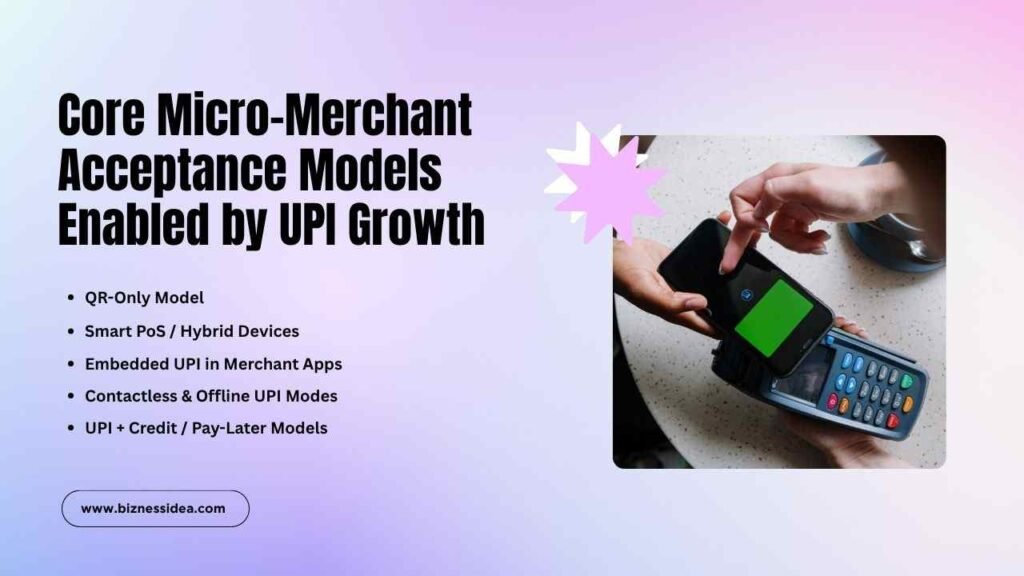
As UPI growth expands, acceptance models are evolving. Here are the most relevant ones:
QR-Only Model
This remains the simplest and most scalable. Merchants display printed or dynamic UPI QR codes (e.g. BharatQR) and customers scan & pay. Because cost is near zero and setup is minimal, it’s widely used for micro-merchants (street stalls, small shops).
NPCI’s open standards and no merchant-fee policy have made QR acceptance virtually default in small retail. (Source: Montran)
Smart PoS / Hybrid Devices
With UPI growth enabling more value, devices that combine QR, card, and app acceptance are becoming popular. Vendors such as Pine Labs or PhonePe’s Smart POD blur the lines between smartphone, speaker, POS, and UPI terminal. (Recent PhonePe SmartPOD launch)
These devices allow merchants to manage payments, handle transactions, and access analytics in one device.
Embedded UPI in Merchant Apps
Merchants using software (billing, inventory, delivery) can have UPI acceptance built into their apps. Rather than switching apps, they click “pay” inside their own interface. This integration reduces friction and increases adoption in structured micro-merchant channels.
Contactless & Offline UPI Modes
For areas with poor connectivity, fallback models like UPI Lite, offline QR, or delayed reconciliation are emerging. UPI’s architecture has evolved to support micro-ticket offline flows, making it feasible even in low-connectivity zones. (Source: NPCI / Montran)
UPI + Credit / Pay-Later Models
With UPI growth, credit-on-UPI is gaining momentum: when customers pay via UPI-linked credit cards or BNPL frameworks, merchants still receive instant settlement. In fact, ~75% of card-ON-UPI transactions occur at small merchants.
This model boosts purchasing power without harming merchant liquidity.
How UPI Growth Is Forcing Changes in Acceptance Strategy
Lower margins, higher volume model
As UPI enables ultra-micro transactions, acceptance models must run on razor-thin margins but high frequency. Merchants expect zero or minimal fees; fintechs must monetize via value layers (analytics, loyalty, embedded finance).
Interoperability as a foundation
Because UPI is interoperable across banks and apps, acceptance models must adopt open standards. Devices or platforms that lock merchants into proprietary systems will lose out.
Trust, education, and support become differentiators
Even with UPI growth, many micro-merchants resist due to fear of fraud or complexity. Acceptance models that come with training, risk mitigation, warranty or support gain trust.
Data-as-asset monetization
Acceptance platforms collect transaction flows, consumption patterns, and merchant behavior data. Monetizing anonymized insights (for credit underwriting, inventory forecasting) forms a revenue stream beyond payment fees.
Case Insights: UPI Growth & Micro-Merchant Models in Action
BharatPe / PhonePe / Paytm’s hybrid merchant strategies
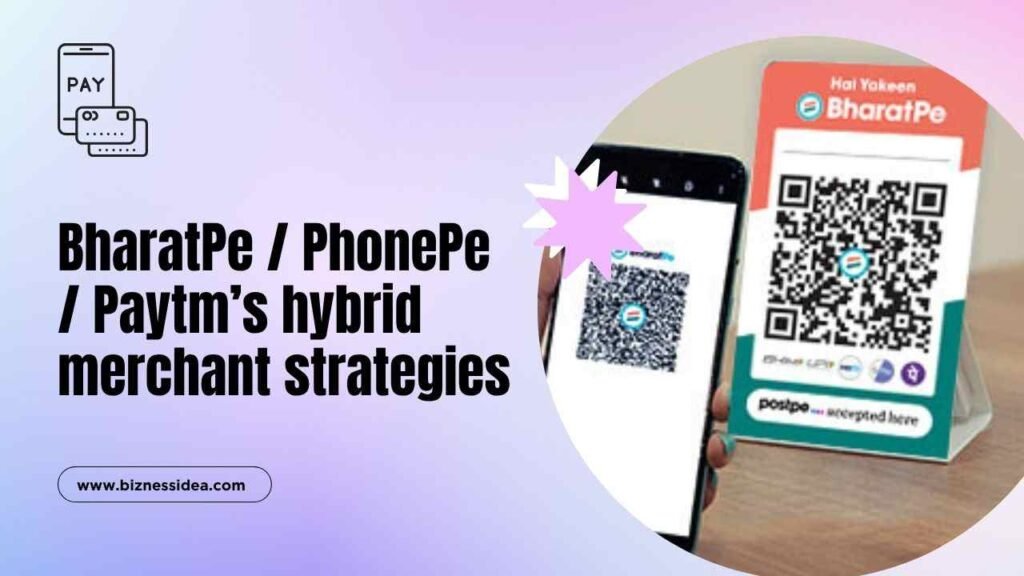
BharatPe initially focused on QR codes, later added lending and merchant tools—transforming their acceptance model into an ecosystem.
PhonePe’s SmartPOD device brings card + QR + voice/IoT interactions for micro merchants.
Paytm’s merchant dashboard, merchant loyalty programs, and integrations show layered acceptance + retention strategy.
SoundBoxes & Smart Speakers for Merchant Use
A study of “merchant adoption of UPI soundboxes” found that street vendors using soundboxes accept more digital payments, reduce errors, and improve customer trust. (Source: SAGE merchant adoption case)
Rural & small-town strategies: PayNearby, Sarvatra
PayNearby helps local agents become financial access points; merchants in these networks accept UPI via storefront devices.
Sarvatra Technologies powers UPI for many co-operative banks and rural banks, bringing acceptance into underbanked areas. (Source: Wikipedia Sarvatra)
Challenges & Mitigations as UPI Growth Accelerates
- Connectivity & electricity constraints: Offline/low-bandwidth modes and backup power help.
- Fraud & security risk: Real-time fraud detection and merchant education are essential.
- Merchant literacy & trust: Onboarding and handholding, simple UX, warranty assurances help overcome reluctance.
- Hardware cost: Shared or leasing models reduce the upfront burden for micro merchants.
- Regulation & compliance: Adhering to NPCI mandates, data protection law compliance, and settlement norms is necessary.
While acceptance models evolve, sustainable adoption depends on balancing cost, reliability, and trust.
Conclusion
The story of UPI growth in India is not just about payments — it’s about reimagining how merchants, even the smallest ones, operate. As UPI transaction volumes soar, acceptance models are forced to adapt: QR-first, hybrid devices, embedded acceptance, credit-on-UPI, offline solutions — all tailored for micro merchants.
For fintech entrepreneurs, the opportunity lies in building acceptance models that are ultra-light, interoperable, trustable, and smartly monetizable. For micro-merchants, it means access to digital tools that can amplify sales, reduce risk, and bring them into the formal economy.
As India marches into a future where UPI becomes the backbone of payments, the success of micro-merchant acceptance models will determine how inclusive and vibrant the digital economy truly becomes.
FAQs
Q1. What is UPI growth?
Ans. “UPI growth” refers to the rising adoption — in volume, value, and merchant acceptance — of India’s Unified Payments Interface system across consumer and merchant use cases.
Q2. How is UPI growth helping micro-merchants accept payments?
Ans. With rising UPI volume, acceptance models like QR codes, smart POS, embedded UPI, and UPI-linked credit become viable, low-cost options for micro merchants.
Q3. What are the biggest challenges in UPI acceptance for micro-merchants?
Ans. Challenges include poor connectivity, hardware cost, digital literacy, trust/fraud concerns, and regulatory compliance.
Q4. Can micro-merchants accept credit payments via UPI?
Ans. Yes. UPI’s architecture allows “card-on-UPI” and BNPL models where customers pay with credit but merchants receive immediate settlement. (Source: ET report on UPI card transactions)
Q5. What are offline or fallback models for UPI acceptance?
Ans. UPI Lite, offline QR modes, and delayed reconciliation help acceptance in low-connectivity zones while maintaining transaction consistency.
Q6. Are there examples of acceptance innovation driven by UPI growth?
Ans. Yes. Devices like UPI soundboxes, SmartPODs, embedded UPI in billing apps, and small-town agent networks like PayNearby are prime examples.