






India’s electric vehicle (EV) journey is no longer a concept of the future. It is happening right now. EV sales are rising steadily, government policies are becoming clearer, and consumers are slowly gaining confidence. However, one major question still worries most people: Is India’s EV charging infrastructure ready?
Without reliable charging options, even the best electric vehicle becomes inconvenient. Therefore, EV infrastructure plays a critical role in India’s clean mobility transition. It determines how fast EV adoption grows, how confident buyers feel, and how businesses invest in the ecosystem.
This complete guide explains electric vehicle charging infrastructure in India in simple language. Whether you are a student, EV buyer, entrepreneur, or policy-aware reader, this article will help you understand how EV infrastructure works, where India stands today, and what lies ahead.
What Is EV Charging Infrastructure? (Simple Explanation)
EV charging infrastructure refers to the complete system that supports charging electric vehicles. It includes charging stations, power supply connections, software systems, payment platforms, and grid integration. In simple terms, it is everything that allows an electric vehicle to charge safely and efficiently.
Unlike petrol pumps, EV charging infrastructure is more flexible. Charging can happen at homes, offices, parking lots, highways, malls, and even workplaces. However, this flexibility also makes planning more complex.
In India, electric vehicle charging infrastructure must handle diverse challenges. Cities are crowded, electricity demand fluctuates, and public awareness is still developing. Therefore, infrastructure planning goes beyond installing chargers. It involves location planning, power availability, charging speed, and user convenience.
Moreover, EV infrastructure is closely linked to the power grid. Charging thousands of vehicles simultaneously requires smart load management. As a result, modern EV infrastructure relies heavily on digital systems.
Understanding this foundation is important because EV adoption will not succeed unless charging becomes easy, reliable, and accessible across India.
Types of EV Charging Infrastructure in India
EV infrastructure is not one-size-fits-all. Different use cases require different charging solutions. Therefore, India’s EV ecosystem uses multiple types of chargers and setups.
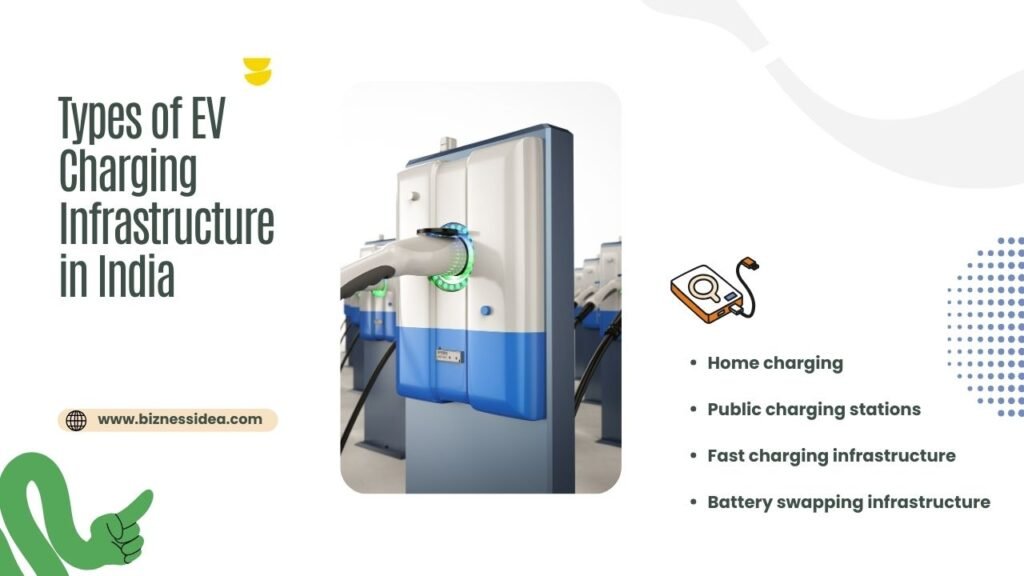
- Home charging is the most common form today. Most electric two-wheelers and cars are charged overnight using standard AC chargers. This option is convenient and cost-effective, especially for daily commuters.
- Public charging stations are essential for long-distance travel and urban users without private parking. These stations are usually installed in malls, metro stations, fuel stations, and highways. They reduce range anxiety and build trust in EVs.
- Fast charging infrastructure is growing rapidly. DC fast chargers can charge an EV up to 80% in under an hour. These chargers are critical for highways, commercial fleets, and taxis.
- In addition, battery swapping infrastructure is emerging, especially for two-wheelers and delivery vehicles. Instead of charging, users swap discharged batteries for charged ones, saving time.
Each type serves a unique purpose. Therefore, a balanced mix is necessary for EV infrastructure in India to succeed.
Current Status of EV Infrastructure in India
India’s EV infrastructure has improved significantly over the last few years. However, it is still unevenly distributed. Major cities like Delhi, Bengaluru, Mumbai, and Pune have seen faster deployment, while smaller towns are catching up slowly.
Public sector companies, such as Indian Oil, BPCL, and NTPC, have installed charging stations at their fuel outlets and in public locations. At the same time, private players and startups are expanding charging networks in urban areas.
Highways are also receiving attention. Charging corridors are being developed on key national highways to support intercity EV travel. This development is important because it reduces range anxiety for long-distance users.
However, gaps still exist. Many charging stations face low utilization due to lack of awareness or poor location planning. Additionally, charger downtime and inconsistent maintenance can negatively impact the user experience.
Despite these challenges, momentum is strong. As EV sales rise, infrastructure growth is accelerating. Therefore, EV infrastructure India is progressing, but it still needs coordinated planning and execution.
Government Policies Supporting EV Infrastructure in India
Government support plays a crucial role in building electric vehicle infrastructure in India. Recognizing this, both central and state governments have introduced multiple initiatives.
- The FAME (Faster Adoption and Manufacturing of Electric Vehicles) scheme provides financial support for EVs and charging infrastructure. It encourages public and private players to set up charging stations.
- In addition, the government has allowed private charging stations without a license, which simplifies deployment. Guidelines also promote chargers in residential societies and commercial buildings.
- State governments have introduced their own EV policies. For example, Delhi, Maharashtra, Tamil Nadu, and Gujarat offer incentives for charging infrastructure installation.
- Moreover, public-private partnerships are encouraged to speed up deployment. Land access, power tariffs, and capital subsidies are provided in some regions.
However, policy execution varies by state. Therefore, while the framework exists, consistent implementation remains a challenge.
Challenges Facing EV Infrastructure in India
Despite progress, India’s EV charging infrastructure faces several obstacles. Understanding these challenges is important for realistic expectations.
One major issue is power availability. Charging stations require stable electricity supply, which can be difficult in areas with frequent outages. Therefore, grid upgrades and energy storage solutions are needed.
Another challenge is land availability, especially in urban areas. Finding space for public charging stations in crowded cities is expensive and complex.
Cost is also a concern. Fast chargers are capital-intensive, and returns take time. As a result, private investors often hesitate without clear demand visibility.
In addition, lack of standardization creates confusion. Different connectors, payment systems, and apps reduce user convenience.
Finally, consumer awareness remains low. Many EV owners are unaware of nearby charging stations or optimal charging practices.
Solving these challenges requires coordination between governments, utilities, businesses, and consumers.
Role of Private Companies and Startups in EV Infrastructure
Private companies and startups are driving innovation in EV infrastructure India. While government support creates the foundation, private players bring speed, technology, and customer focus.
Charging network operators are expanding rapidly in metros and highways. They focus on user-friendly apps, real-time availability, and digital payments.
Energy companies are integrating renewable energy with charging stations. Solar-powered chargers reduce grid load and improve sustainability.
Startups are also innovating in battery swapping, fleet charging, and smart charging software. These solutions address specific use cases like last-mile delivery and ride-hailing services.
Moreover, real estate developers are integrating EV chargers into new residential and commercial projects. This trend normalizes EV charging as a standard amenity.
Therefore, private participation is essential for scaling electric vehicle charging infrastructure beyond government capacity.
Future of EV Infrastructure in India
The future of EV charging infrastructure in India looks promising, but it will evolve gradually rather than overnight.
Smart charging systems will become common. These systems manage charging based on grid load, electricity prices, and vehicle usage. As a result, charging will become more efficient and cost-effective.
Renewable energy integration will increase. Solar and wind power will support charging stations, reducing carbon footprint and grid dependency.
Highway charging networks will expand further. Intercity EV travel will become easier, encouraging adoption among long-distance drivers.
In addition, standardization will improve. Unified connectors, payment platforms, and interoperability will enhance user experience.
Overall, EV infrastructure in India will mature as demand rises and technology advances. The transition will not be instant, but it is clearly underway.
Business and Investment Opportunities in EV Infrastructure
EV charging infrastructure is not just a mobility issue; it is also a business opportunity. As EV adoption grows, demand for charging services will rise.
Entrepreneurs can explore charging station setup, maintenance services, software platforms, and energy management solutions. Commercial fleets require dedicated charging infrastructure, creating B2B opportunities.
Real estate developers can add value by offering EV-ready buildings. Retail locations benefit from increased footfall at charging stations.
In addition, data analytics, payment systems, and grid optimization services will see growth.
Therefore, electric vehicle infrastructure India presents long-term opportunities for businesses willing to invest patiently.
Conclusion
EV charging infrastructure in India is the backbone of the country’s electric mobility future. While challenges exist, progress is steady and promising. With supportive policies, private innovation, and growing awareness, India is gradually building an ecosystem that can support mass EV adoption.
For consumers, understanding EV infrastructure reduces uncertainty. For businesses, it opens new opportunities. And for the country, it moves India closer to a cleaner, more sustainable transport system.
FAQs
Que 1. What is EV charging infrastructure?
Ans. EV charging infrastructure refers to the network of charging stations, power systems, and digital platforms that support electric vehicle charging.
Que 2. How developed is EV infrastructure in India?
Ans. EV infrastructure in India is growing rapidly in major cities and on highways, but it is still unevenly distributed across regions.
Que 3. What are the types of EV infrastructure?
Ans. Common types include home charging, public charging stations, fast DC chargers, and battery swapping stations.
Que 4. Who is responsible for EV infrastructure in India?
Ans. Both government and private companies play a role. Public sector companies, startups, and utilities are actively involved.
Que 5. What are the biggest challenges for EV infrastructure in India?
Ans. Key challenges include power availability, land access, high setup costs, lack of standardization, and low awareness.
Que 6. Is EV infrastructure a good business opportunity?
Ans. Yes, EV infrastructure offers long-term business potential as electric vehicle adoption continues to rise.