








As financial crime reaches record global levels, businesses in Australia find themselves on the front lines of a high-stakes battle against money laundering and terrorism financing. AML/CTF Employee Training is no longer optional—it plays a critical role in helping organisations comply with AUSTRAC regulations and build a strong human firewall against financial crime.
Effective AML/CTF Employee Training serves as the primary defence, ensuring that staff are not just aware of the risks, but are actively capable of disrupting illicit financial flows. For any modern business providing designated services, robust anti-money laundering training for staff is the foundation of a resilient and legally compliant operation.
Understanding AML/CTF Employee Training
To protect a business from being exploited by criminal syndicates, one must first understand what they are up against. Training is more than a slide deck; it is a strategic knowledge transfer designed to safeguard the integrity of the financial system.
What Is AML/CTF Training?
In simple terms, AML/CTF training for employees is a structured educational program that empowers staff to identify, manage, and mitigate the risks of money laundering and terrorism financing. It moves beyond theory, teaching employees how to spot suspicious financial activity in real-time. By bridging the gap between legal obligations and daily operations, this training ensures every team member understands their specific reporting duties and the company’s internal safety protocols.
Why AML/CTF Training Is Required in Australia
In Australia, the regulatory heavy lifter is AUSTRAC. Under the AML/CTF Act 2006, any business providing “designated services” from banks and casinos to the newly regulated “Tranche 2” sectors like real estate and law must maintain a risk-aware workforce.
AUSTRAC mandates that employees exposed to financial crime risks receive tailored training. This isn’t a suggestion; it’s a legal requirement. Programs must explicitly cover the organization’s specific AML/CTF obligations, how to handle suspicious transaction reporting (SMRs), and the internal nuances of the business’s risk management strategy.
Why AML/CTF Employee Training Is Critical for Businesses
Think of AML training as an insurance policy that works. Without it, your business is essentially leaving the front door unlocked in a neighbourhood known for high-tech heists.
Preventing Financial Crime Risks
A well-trained eye is often the only thing standing between your business and a multi-million-dollar laundering scheme. When staff receive comprehensive AML compliance training, they become proficient at detecting the early warning signs of money laundering, fraud, and terrorism financing.
This early detection doesn’t just stop a single crime; it strengthens your entire internal control framework, making your business an unattractive target for criminals looking for an easy path to clean their cash.
Ensuring Regulatory Compliance
Let’s be honest: AUSTRAC doesn’t take “we didn’t know” as an excuse. Non-compliance can lead to staggering civil penalties and the kind of regulatory scrutiny that halts growth. By prioritising AML/CTF training for employees, you ensure that your team follows the exact procedures required by law.
This proactive approach turns compliance from a looming threat into a standard operating procedure, keeping your business on the right side of the law and away from the auditor’s “naughty list.”
Protecting Business Reputation
In the digital age, trust is a currency. A business linked even unintentionally to terrorism financing or organised crime will see its brand value evaporate overnight. Training demonstrates to your clients, partners, and stakeholders that you are committed to ethical operations.
It signals that you value integrity over convenience, which is essential for maintaining long-term consumer confidence in a competitive market.
Key Components of Effective AML/CTF Training for Employees
Not all training is created equal. To be effective, a program needs to be as dynamic as the criminals it aims to stop.
Understanding Money Laundering and Terrorism Financing Risks
Static training is useless. Effective programs must incorporate real-world “typologies”, and the specific methods criminals use to move money. This includes everything from “smurfing” (breaking large sums into small amounts) to the use of shell companies.
By analysing emerging trends and sector-specific risks, such as those prevalent in digital assets or real-world property, employees can understand the why behind the red flags.
Identifying Suspicious Activities and Transactions
This is where the rubber meets the road. Staff need to know what a “red flag” looks like in their specific role. Is it a customer who is unusually nervous? Or perhaps a sudden, unexplained spike in transaction volume from a previously dormant account?
Training should provide a clear roadmap for identifying these anomalies and, crucially, how to escalate them through internal reporting channels without “tipping off” the suspect.
Learning Internal AML Policies and Procedures
Every business has a different risk appetite and different workflows. Training must be grounded in the company’s specific AML/CTF Program.
This includes understanding the “risk-based approach”, the idea that higher-risk customers require more rigorous checks, and knowing exactly which internal reporting channel to use when something feels “off.” It’s about making the company’s policy a living document.
Role-Based AML Training
A “one-size-fits-all” approach usually fits no one. A compliance officer needs a much deeper dive into the AML/CTF Rules than a receptionist. Regulators expect training to be tailored.
Onboarding teams need to master Customer Due Diligence (CDD), while transaction monitoring staff must be experts in pattern recognition. Tailoring the content ensures that every employee gets the specific tools they need for their unique slice of the business.
Who Needs AML Training in an Organisation?
If an employee’s work could potentially touch a “designated service,” they need to be in the loop.
Customer-Facing Employees
Your frontline staff are your primary sensors. Whether they are bank tellers, real estate agents, or retail staff, they are the ones who see the customer’s behaviour first-hand. They must be experts at identifying unusual transactions and knowing when a client’s story doesn’t quite add up.
Compliance Officers and Risk Teams
These are the specialists. They require advanced AML compliance training that covers the “meat” of the legislation. They need to understand the nuances of international sanctions, beneficial ownership structures, and how to interact with AUSTRAC during an audit.
Senior Management and Directors
Compliance starts at the top. Directors and senior leaders must understand their AML obligations because they are ultimately responsible for the program’s oversight. If the leadership doesn’t value the training, the rest of the organisation won’t either.
Training for this group should be provided during onboarding and refreshed regularly to keep up with evolving legal standards.
Best Practices for Implementing AML Training in Australia
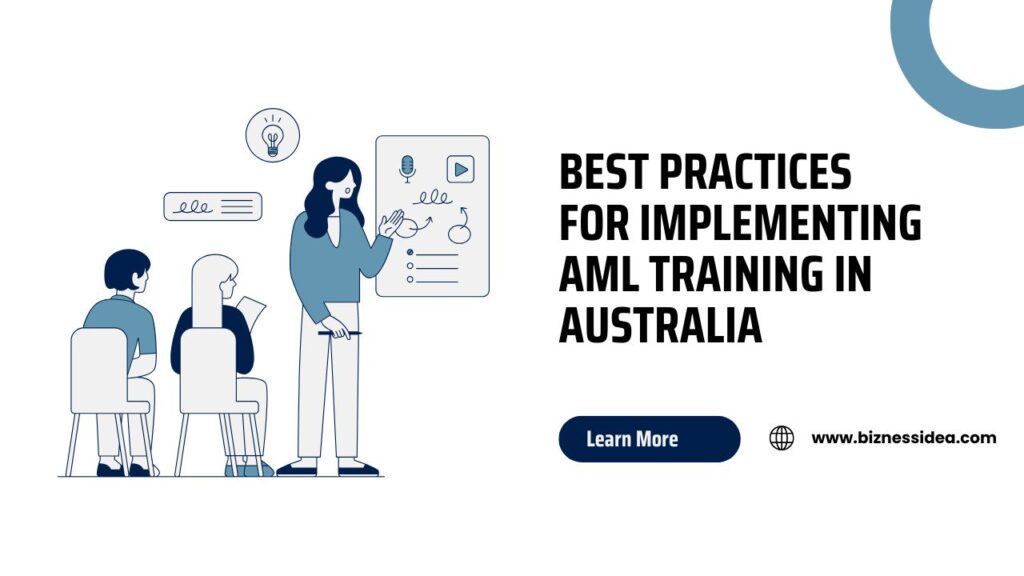
Implementation is where many businesses stumble. A “set and forget” mentality is a recipe for disaster.
Provide Regular and Updated Training
Criminals are nothing if not creative. As they develop new techniques, your training must evolve. Annual refreshers are the industry gold standard, but you should also trigger “just-in-time” training whenever there is a significant regulatory update or a shift in the business’s risk profile.
Use Multiple Training Methods
Death by PowerPoint is real, and it’s not effective. Mix it up. Use online modules for flexibility but follow them up with interactive workshops or scenario-based learning where employees must solve a “mock” suspicious activity case. This hands-on approach ensures the knowledge sticks.
Maintain Training Records
If you can’t prove it happened, in the eyes of a regulator, it didn’t happen. Maintain meticulous, audit-ready logs that document who was trained, when they were trained, and what the content covered. This documentation is your best friend during an AUSTRAC review.
Evaluate Training Effectiveness
Don’t just assume they learned it. Use quizzes, compliance reviews, and even “mystery shopper” scenarios to test if the staff can spot a red flag. AUSTRAC expects organizations to not only provide training but to actively monitor whether that training is working.
Benefits Of AML Training for Business Owners
Beyond just staying out of jail, there are tangible business advantages to a well-trained workforce.
Reduced Compliance Risk
The most immediate benefit is a drastic reduction in the likelihood of a compliance breach. Well-trained employees are less likely to make the kind of small, “human error” mistakes that lead to massive regulatory fines and expensive remediation projects.
Improved Fraud Detection
There is a huge overlap between money laundering and traditional fraud. By training staff to recognize suspicious behavior as part of their AML Training in Australia, you inherently improve your company’s ability to catch internal and external fraud before it impacts the bottom line.
Stronger Corporate Governance
Investing in AML compliance training fosters a culture of accountability. When everyone knows the rules and why they exist, it elevates the overall standard of risk management across the entire organization. It’s about building a business that is not only profitable but also fundamentally sound and resilient.
Conclusion
At the end of the day, AML/CTF Employee Training is not a luxury or an optional extra; it is a core business necessity. In the current Australian regulatory climate, being “unaware” is a liability that no modern business can afford to carry.
By investing in comprehensive, role-based AML Training in Australia, you are doing more than just satisfying a legal requirement. You are protecting your employees from being exploited, safeguarding your business’s reputation, and playing a vital role in the security of the national financial system. Compliance is a journey, and a well-trained team is the only way to navigate it successfully.
FAQs
Que 1. How often should employees receive AML/CTF training?
Ans. AML/CTF training should be provided when an employee joins the organisation and continues throughout their employment. Many businesses provide refresher training annually or whenever there are changes to regulations, business risks, or internal AML policies to ensure staff stay updated.
Que 2. What topics should AML/CTF training for employees cover?
Ans. Effective AML compliance training should cover key areas such as money laundering and terrorism financing risks, the organisation’s AML/CTF policies, suspicious transaction indicators, and the correct process for submitting Suspicious Matter Reports (SMRs).
Que 3. Which employees in an organisation need AML/CTF training?
Ans. Training should be provided to all personnel who perform duties related to designated services or AML compliance. This often includes customer-facing employees, compliance teams, managers, directors, and contractors involved in financial transactions or customer onboarding.
Que 4. How can businesses prove AML training compliance during an audit?
Ans. Businesses should maintain clear training records that show who completed the training, when it was conducted, and what topics were covered. Keeping certificates, attendance logs, and training schedules helps demonstrate compliance during an AUSTRAC review or regulatory audit.