







If you’re operating in Australia’s financial, fintech, or professional services sectors, the regulatory landscape probably feels like it’s shifting beneath your feet. With AUSTRAC tightening its oversight, ML/TF risk assessment in Australia has moved from a “good to have” internal document to a non-negotiable pillar of business operations. It isn’t just about ticking a box for a regulator; it’s about understanding the specific vulnerabilities of your business model.
Whether you’re a crypto start-up, a seasoned remittance provider, or a professional service firm, conducting a thorough money laundering risk assessment in Australia is your first line of defence. In this guide, we’ll break down the strategic requirements of the AML/CTF Act, explore the nuances of risk identification, and provide practical solutions to keep your business compliant and secure in an increasingly complex financial crime environment.
What Is ML/TF Risk Assessment in Australia?
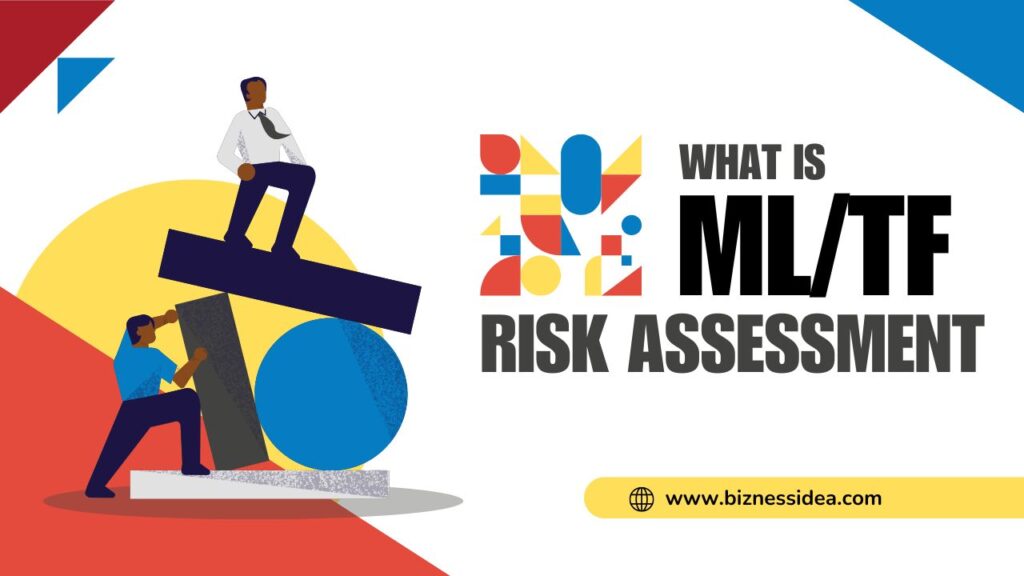
In essence, an ML/TF risk assessment is a formal process of identifying, managing, and mitigating risks of money laundering (ML) and terrorism financing (TF). It is not a generic document, but a customized analysis of how your business can be used by criminal actors.
Definition of ML/TF Risk Assessment
A money laundering risk assessment in Australia involves a deep dive into your business ecosystem. It’s the process of identifying where your services are vulnerable—whether through high-risk customer profiles, anonymous transaction methods, or geographic exposure. The goal is to understand the “residual risk” that remains after you’ve applied your internal controls.
Why It Matters for Australian Businesses
Compliance is more than just avoiding the “heavy hand of AUSTRAC”; it is about business integrity. A sound review will shield you from serious civil fines, which can be in the order of tens of millions of dollars. Not to mention the legal implications, it also protects your reputation.
In an era where “de-banking” is a real threat, showing banks and partners that you have a sophisticated internal risk management practice is essential for survival.
Regulatory Framework for ML/TF Risk Assessment in Australia
The financial crime regime in Australia is regulated by the Anti-Money Laundering and Counter-Terrorism Financing Act 2006 (AML/CTF Act). This regime is not prescriptive; it is “risk-based,” which means that the level of scrutiny you exercise has to be commensurate with the risk you are exposed to.
The AML/CTF Act and AUSTRAC Requirements
AUSTRAC, our national financial intelligence agency, requires all “reporting entities” to maintain an enterprise-wide risk assessment. This document must be documented, approved by senior management, and regularly updated. Under the Act, you are expected to show how you arrived at your risk ratings and what specific steps you are taking to mitigate those risks. It’s no longer enough to have a generic policy; AUSTRAC wants to see the “why” behind your strategy.
Businesses Required to Conduct ML/TF Risk Assessments
If you provide “designated services,” you are a reporting entity. This includes:
- Banks and Credit Unions: The traditional front line.
- Cryptocurrency Exchanges: Now under heavy scrutiny regarding digital asset flows.
- Remittance Providers: High-velocity international transfers.
- Casinos and Gaming: High-cash environments.
- The “Gatekeepers”: Lawyers, accountants, and real estate agents (currently expanding under “Tranche 2” reforms).
Key Risk Factors in a Money Laundering Risk Assessment in Australia
To build an effective assessment, you need to look through four primary lenses. These dimensions help you categorise where the “bad actors” are most likely to enter your system.
Customer Risk
Not all customers are equal. You must evaluate the risk posed by Politically Exposed Persons (PEPs), customers with complex or opaque beneficial ownership structures, and those operating in high-risk industries like weapons or unregulated gambling. If a customer’s activity doesn’t match their stated profile, the risk level climbs.
Product and Service Risk
Some financial products are inherently more attractive to money launderers. For example, international wire transfers, anonymous stored-value cards, and cryptocurrency services offer the speed and layer of anonymity that criminals crave. High-value transactions that allow for the rapid movement of wealth require the most stringent oversight.
Delivery Channel Risk
How do you “meet” your customers? A face-to-face onboarding process in a local branch carries a different risk profile than a 100% digital onboarding process via a mobile app. Digital-only channels and the use of third-party agents can create “blind spots” that require specific technological safeguards.
Geographic Risk
Where is the money coming from, and where is it going? A terrorism financing risk assessment in Australia must look closely at transactions involving high-risk jurisdictions, countries with weak AML frameworks, those under international sanctions, or regions known for active conflict. Cross-border flows are the highest-risk geographic factor.
Step-by-Step Process to Conduct a Terrorism Financing Risk Assessment in Australia
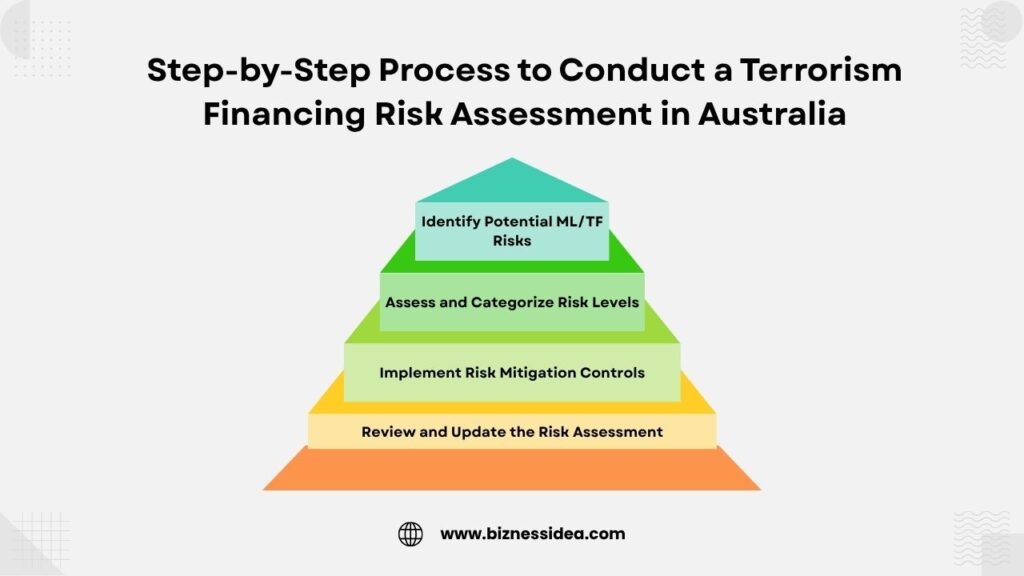
Assessing terrorism financing requires a slightly different mindset than money laundering. While ML usually involves large sums of “dirty” money, TF often involves small amounts of “clean” money intended for a dark purpose.
Identify Potential ML/TF Risks
Start by mapping every service you offer. Where could a person hide the source of funds? Review your customer base and identify exposure points, such as non-profit organizations or accounts with frequent small-value transfers to high-risk zones.
Assess and Categorize Risk Levels
Assign a rating to each identified risk: Low, Medium, or High. This isn’t just a guess; it should be based on the likelihood of the event occurring and the impact it would have on your business and the Australian financial system.
Implement Risk Mitigation Controls
Once you know your risks, you need “treatments.” This might include Enhanced Due Diligence (EDD) for high-risk clients, automated transaction monitoring, or stricter identity verification for certain geographic regions.
Review and Update the Risk Assessment
Your risk assessment is a living document. You must update it whenever you launch a new product, expand into a new country, or when AUSTRAC issues new guidance. A stale risk assessment is essentially a non-compliant one.
Common Challenges Businesses Face with ML/TF Risk Assessments
The theory is simple, but the practice is often gruelling for many Australian firms.
Lack of Internal Compliance Expertise
Most small to mid-sized businesses don’t have a dedicated AML officer with years of experience. Expecting a CFO or an operations manager to keep up with AUSTRAC’s evolving expectations is a tall order.
Complex Regulatory Expectations
The rules change. With the “Tranche 2” reforms looming and constant updates to the FATF (Financial Action Task Force) standards, staying current requires constant vigilance that most businesses can’t afford to do manually.
Managing Large Volumes of Transaction Data
If you’re processing thousands of transactions a day, spotting a “needle in a haystack” becomes impossible without the right tools. Human error is the greatest risk in manual data review.
Technology and Compliance Solutions for ML/TF Risk Assessment
Thankfully, we aren’t in the era of paper ledgers anymore. Modern technology has turned compliance from a burden into a competitive advantage.
Automated AML Compliance Platforms
Modern platforms offer AI-driven transaction monitoring and automated risk scoring. These tools can flag suspicious patterns like “structuring” (breaking large deposits into small ones) far faster and more accurately than any human team.
Benefits of Using Compliance Technology
Beyond just catching criminals, tech solutions provide an “audit trail.” When AUSTRAC comes knocking, you can produce a report in seconds showing exactly how you assessed a specific risk. It reduces the operational workload and allows your team to focus on growth.
When to Consider AML Compliance Consulting
Sometimes, software isn’t enough. Many businesses bring in consultants to build their initial ML/TF risk assessment in Australia framework. An expert eye is invaluable for audit preparation and ensuring your “Program Part A and B” are legally sound.
Best Practices for Effective ML/TF Risk Assessment in Australia
To stay ahead of the curve, follow these five pillars:
- Document Everything: If it isn’t written down, it didn’t happen in the eyes of the regulator.
- Train Your Team: A risk assessment is only as good as the staff implementing it.
- Use a Risk-Based Approach: Focus your heaviest resources on your highest risks.
- Monitor AUSTRAC Alerts: Subscribe to their updates; they are the ultimate source of truth.
- Audit Periodically: Have an independent party review your framework every 1–2 years.
Conclusion
A thorough ML/TF risk assessment in Australia is no longer a peripheral exercise, but a core business imperative for any business that engages in financial transactions. While the regulatory environment can be overwhelming, effective management is not only about complying with AUSTRAC regulations, but it can also save your business from becoming a pawn in global financial crime syndicates.
Through a structured approach and technology, you can transform a cumbersome legal obligation into an efficient business process. If you’re unsure about your vulnerabilities, now is the time to address your compliance gap before it turns into a financial liability.
FAQs
Que 1. Which businesses must conduct an ML/TF risk assessment?
Ans. Any business that provides designated services under the AML/CTF Act must conduct an ML/TF risk assessment. This includes sectors such as banks, remittance providers, digital currency exchanges, gambling operators, and other financial service providers regulated by AUSTRAC.
Que 2. What factors should be considered in a money laundering risk assessment in Australia?
Ans. A proper risk assessment should consider several key factors, including the types of customers served, the services provided, the delivery channels used, and the countries involved in transactions. These elements help businesses identify where financial crime risks may arise and determine the level of controls required to manage those risks effectively.
Que 3. How does an ML/TF risk assessment support AML/CTF compliance?
Ans. An ML/TF risk assessment directly informs the policies, procedures, and controls included in an organisation’s AML/CTF program. By identifying specific vulnerabilities, businesses can implement appropriate safeguards such as customer due diligence, transaction monitoring, and internal reporting procedures to mitigate financial crime risks.