







If you’re running a business in finance, remittance, crypto, or other designated services in Australia, the letters AUSTRAC probably bring a mix of respect and anxiety. The regulator’s focus has never been sharper, with recent high-profile penalties highlighting the serious cost of compliance failures. Simply put, if your business is a “reporting entity,” having a robust AML/CFT program isn’t optional; it’s a legal must.
But beyond avoiding fines, a strong program protects your reputation and the integrity of the financial system. Feeling overwhelmed? Don’t worry. This guide cuts through the complexity to give you a clear, step-by-step path to build an AML/CFT program in Australia that meets AUSTRAC’s standards, turning a compliance burden into an operational advantage.
What Is an AML/CFT Compliance Program?
An AML/CFT compliance program is your business’s formal, documented shield against financial crime. Its purpose is to proactively detect, deter, and disrupt attempts to launder money or fund terrorism through your services. In practice, this means having systems to know your customers, monitor their transactions, and report suspicious activity to AUSTRAC. A well-designed program doesn’t just tick a box for the regulator; it actively protects your business from being used as a vehicle for crime, safeguarding your assets and your standing in the market.
Requirements for AML/CFT Program in Australia
Navigating Australia’s AML/CFT landscape starts with understanding the rulebook. The core framework is the Anti-Money Laundering and Counter-Terrorism Financing Act 2006 (AML/CTF Act), enforced by the Australian Transaction Reports and Analysis Centre (AUSTRAC). This isn’t about vague guidelines; it’s prescriptive law.
The act mandates that reporting entities must adopt a risk-based approach to prevent criminals from abusing their services. Think of AUSTRAC as both a coach and a referee, they provide guidance and rules, but they also have the power to issue substantial fines for non-compliance. Aligning your operations with these AUSTRAC AML program requirements from the start is the only way to operate with confidence.
Key AUSTRAC AML Program Requirements Businesses Must Follow
AUSTRAC’s requirements boil down to a few critical expectations. Your program must be anchored by a formal risk assessment, have ongoing customer due diligence and transaction monitoring processes, and fulfill strict reporting obligations for suspicious matters, thresholds, and international funds transfers. Crucially, there must be clear accountability, with a designated person overseeing compliance.
Who Needs an AML/CFT Program in Australia?
You need this program if your business is a “reporting entity.” This broadly includes banks, credit unions, fintechs offering payment products, remittance (money transfer) service providers, bullion dealers, gambling services, and cryptocurrency exchanges (known as Digital Currency Exchange providers). If you’re unsure, the first step is to check AUSTRAC’s detailed list of “designated services” and if what you offer is on that list, compliance is mandatory.
Core Components of an Effective AML/CFT Program in Australia
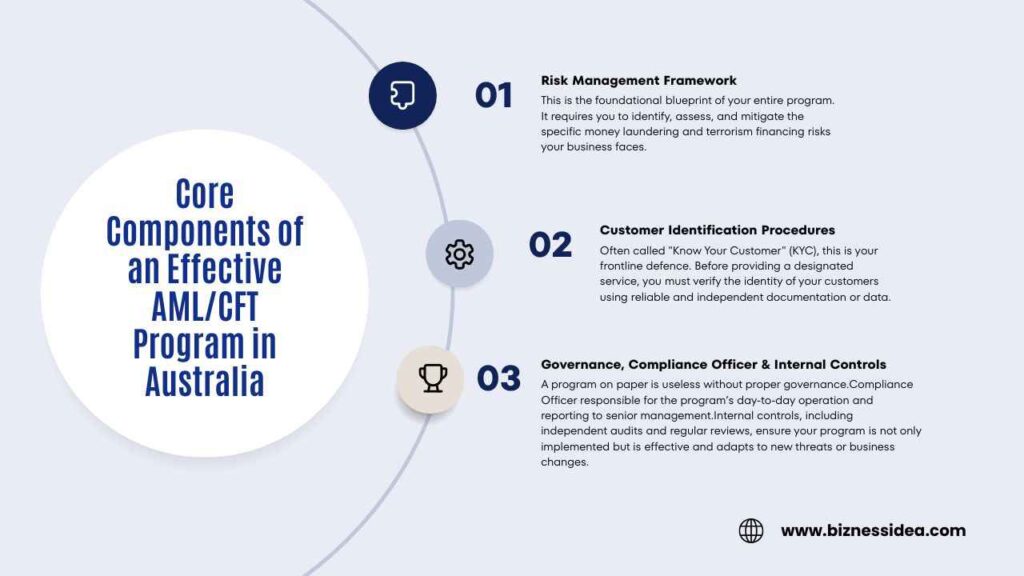
AUSTRAC structures its core requirements into distinct parts. A compliant program isn’t a single document, but an interconnected system built on these pillars.
Risk Management Framework
This is the foundational blueprint of your entire program. It requires you to identify, assess, and mitigate the specific money laundering and terrorism financing risks your business faces. You must analyse risks related to your customer types (e.g., politically exposed persons), the products you offer (e.g., international transfers), your delivery channels (online vs. in-person), and the geographic locations you operate in. Your subsequent controls are then tailored to these assessed risks.
Customer Identification Procedures
Often called “Know Your Customer” (KYC), this is your frontline defence. Before providing a designated service, you must verify the identity of your customers using reliable and independent documentation or data. This isn’t a one-size-fits-all process; the level of verification should be commensurate with the risk the customer presents, as identified in your Part A framework.
Governance, Compliance Officer & Internal Controls
A program on paper is useless without proper governance. You must appoint a designated AML/CTF Compliance Officer responsible for the program’s day-to-day operation and reporting to senior management. Internal controls, including independent audits and regular reviews, ensure your program is not only implemented but is effective and adapts to new threats or business changes.
Step-by-Step Process to Build an AML/CFT Program in Australia
Now, let’s translate those components into actionable steps. Building your program is a logical progression, you can’t write policies until you know your risks.
Step 1: Conduct a Business-Wide AML Risk Assessment
Start by mapping your unique risk profile. Document all your business lines, customer segments, geographic exposures, and transaction methods. Ask: Where could our services be misused? A fintech serving international students will have different risks than a bullion dealer. This documented assessment directly informs every other step.
Step 2: Develop AML/CFT Policies and Procedures
Based on your risk assessment, formally document your policies. This manual should clearly outline your procedures for customer due diligence, ongoing monitoring, reporting to AUSTRAC, and record-keeping. It must be approved by the board or senior management, demonstrating their commitment.
Step 3: Implement Customer Due Diligence (CDD) Processes
Operationalise your KYC policy. Set up systems to collect and verify customer ID (using tools like document verification software). For higher-risk customers, implement Enhanced Due Diligence (EDD), which involves deeper investigation into the source of funds and the customer’s activities. Don’t forget to identify and verify beneficial owners for corporate customers.
Step 4: Deploy Transaction Monitoring and Reporting Systems
Implement a system, whether automated software or manual checks, to monitor customer transactions for unusual patterns that might indicate crime. Crucially, establish a clear internal process for reviewing alerts and, if warranted, submitting Suspicious Matter Reports (SMRs) to AUSTRAC. Timely and accurate reporting is a key regulator expectation.
Step 5: Train Employees and Establish Compliance Culture
Your frontline staff are your best sensors. Conduct regular, role-specific training so they understand red flags, their reporting obligations, and how to use your CDD systems. A strong compliance culture, led from the top, ensures your program lives and breathes in daily operations.
Common AML/CFT Compliance Mistakes Australian Businesses Should Avoid
Many businesses stumble on the same issues. Being aware of these pitfalls can save you from an AUSTRAC audit finding.
Incomplete Risk Assessments
Using a generic, off-the-shelf risk assessment is a major red flag. Your assessment must be tailored, living, and directly reflect your actual business activities. A template that doesn’t match your reality is worse than useless; it shows the regulator you’re not taking your obligations seriously.
Weak Customer Due Diligence Procedures
Relying on easily forged documents or failing to look beyond a corporate structure to find the real beneficial owner creates dangerous gaps. Criminals seek out businesses with weak KYC as easy entry points to the financial system.
Lack of Ongoing Monitoring and Program Updates
A “set and forget” program is a failing program. Your risks evolve, regulations change, and your business grows. Your program must be reviewed and updated at least annually, or when launching new products, to remain effective.
Poor Staff Training and Awareness
Untrained employees will miss suspicious activity and mishandle customer onboarding. Regular, engaging training is non-negotiable for turning policy into practice.
Benefits of Implementing a Strong AML/CFT Program in Australia
While building a program requires effort, the benefits extend far beyond mere compliance.
Regulatory Protection and Reduced Penalties
A demonstrably effective program is your best defence in any regulatory review. It shows AUSTRAC you are proactive and diligent, which can significantly mitigate penalties if an issue is ever found.
Stronger Financial Integrity and Business Reputation
Partners, banks, and investors need to trust you. A mature compliance framework signals that you are a serious, legitimate operator, making it easier to secure banking relationships and attract investment.
Operational Efficiency Through Risk-Based Controls
A risk-based program means focusing your resources where the threats are greatest. This creates smarter, more efficient operations, reduces false positives in monitoring, and provides clearer oversight for management.
Conclusion
Building an effective AML/CFT compliance program in Australia is a structured journey that begins with understanding your unique risks and ends with a culture of vigilance. By following the AUSTRAC AML program requirements to conduct a thorough risk assessment, implement strong customer due diligence, deploy monitoring systems, and commit to ongoing training, you need to transform a regulatory obligation into a cornerstone of your business integrity.
The path can be complex, and many businesses find that partnering with professional compliance experts provides the certainty and specialist knowledge needed to get it right from the start, ensuring sustainable compliance and peace of mind.
FAQs
Que 1. What is an AML/CFT program in Australia?
Ans. An AML/CFT program is a documented framework that explains how a business prevents money laundering and terrorism financing risks. It includes policies, procedures, systems, and controls designed to identify, manage, and report suspicious activity.
Que 2. Is an AML/CFT program mandatory for businesses in Australia?
Ans. Yes. Any business classified as a reporting entity under the AML/CTF Act must develop and maintain an AML/CFT program. This includes sectors such as banks, remittance providers, digital currency exchanges, gambling services, and other businesses that offer designated financial services.
Que 3. What are the main components of an AML/CFT compliance program?
Ans. A typical AML/CFT compliance program includes a money laundering and terrorism financing risk assessment, documented policies and procedures, customer identification processes (KYC), transaction monitoring, reporting obligations, employee training, and internal reviews.
Que 4. What happens if a business fails to implement an AML/CFT program?
Ans. Failure to implement an AML/CFT program can lead to regulatory investigations, financial penalties, and reputational damage. AUSTRAC has the authority to take enforcement action against businesses that do not meet their compliance obligations or fail to properly manage money laundering and terrorism financing risks.